Sunday, June 14, 2015

Forgetting as "Interference" during Consolidation and Retrieval

"With one singular exception, time’s arrow is straight. Unidirectionality of time is one of nature’s most fundamental laws. It has relentlessly governed all happenings in the universe... Galaxies and stars are born and they die, living creatures are young before they grow old, causes always precede effects, there is no return to yesterday, and so on and on. Time’s flow is irreversible.
The singular exception is provided by the human ability to remember past happenings. When one thinks today about what one did yesterday, time’s arrow is bent into a loop. The rememberer has mentally traveled back into her past and thus violated the law of the irreversibility of the flow of time. She has not accomplished the feat in physical reality, of course, but rather in the reality of the mind, which, as everyone knows, is at least as important for human beings as is the physical reality."
-Endel Tulving

Forgetting is probably the scariest thing I can think of short of death itself (indeed, perhaps even scarier). The two phenomena seem to have a lot in common if you think about it! Both are inexorable, incompletely understood, terrifying natural destructions of the self. Both, also, seem to be necessary side-effects of the very processes that enable life and our ability to remember it. Life is the constant (and ultimately losing?) struggle of processes creating order against the prevailing thermodynamic tendency toward disorder (entropy), made possible by a continual flux of energy from the environment. Memory, too, is a way of imposing temporary order on fleeting perceptions, allowing our sensory experience to temporarily persist in the form of impressions which, if attended to and encoded, become memories... at least, until we forget them.

Just imagine "you" without your memories, without the impressions of your past experiences... there's really no such thing! Without memories of the past serving to verify our continued existence, we lose the concept of time altogether and are consigned to exist forever in the present moment. Less existentially dramatic, imagine everyday cases of forgetting like losing access to knowledge you worked hard to acquire, skills you've trained painstakingly to master. Needless to say, I have a morbid fascination with forgetting (and remembering, which we will see is part and parcel). Like those latterday immortality-seekers, in my own way I too care deeply about such preservation... not of life per se (though I do think I support these efforts), but of my memories of my own life as-lived; unadulterated access to my past experiences as-encoded. I'm not asking for superhuman mnemonic powers or an eidetic memory; no, I humbly desire continued access to all the ideas I've had and the things I've tried consciously to remember. It's scary when you realize you don't know what you no-longer know... because you've necessarily forgotten about all the things you've forgotten, all that you once knew. At the same time, even in the face of its many foibles, human memory is an astounding innovation! An apparatus shaped by natural forces to serve only a few basic needs (food/water, shelter/safety, mates...) is currently being used to perform all sorts of amazing feats in a world it simply was not evolved for. But more about memory later; this post is about forgetting.

Forgetting occurs in at least two ways. One is active around the time of initial memory formation (encoding), and the other is active as you recall information from memory (retrieval). I'll give you a foretaste of both phenomena, to be savored at length in due time. The first type of forgetting has to do with the fact that recently formed memories take time to fully consolidate, and during this time they are vulnerable to interference by other mental activity, which can weaken and even eliminate incipient memories! We will talk about how sleep and alcohol actually improve memory for previously learned material by reducing the amount mental activity in the intervening period, which would otherwise interfere with the consolidation process (e.g. Gais, Lucas, & Born, 2006; Bruce & Pihl, 1997; Lamberty et al., 1990). We will also talk about how neuroscience bears this out; recently induced long-term potentiation (LTP) - the neural mechanism thought to underlie memory formation - is inhibited by subsequent LTP, even if the tasks are unrelated (Xu et al., 1998; Abraham, 2003). This damaging effect of new learning has on prior learning becomes less and less pronounced as the delay between new and prior learning is increased. This is super fascinating, so stick around; we'll save this best bit for last.

The second way forgetting can occur is through memory retrieval; that is, remembering one thing may necessarily make it more difficult to remember other things. When you go to retrieve a memory, something has cued you to search for that memory. If many different memories are associated with the same cue, then they "compete" for access to conscious awareness during the memory search; the more of these cue-to-memory associations there are, the more difficult it will be to recall the desired information. Furthermore, increasing the strength of one cue-to-memory association necessarily weakens the associations of all other memories to that cue: this is why it is hard to remember all of the things in a given category, like the wives of Henry VIII. As you recall each additional wife, the relative strengths of the others in memory are thereby diminished, and thus the remaining wives become harder to recall. "Ah, I can never remember that last one!" Selectively retrieving an item from memory, though bolstering future recall for that item, harms our later recall of similar items. As we will see, this negative effect of retrieval may even extend beyond related items; much evidence exists to suggest that retrieval of information is impaired by the previous retrieval of other, unrelated items. This can be viewed as a basic consequence of increasing non-specific mental activity during the retention interval, when presumably the original memories for the to-be-remembered material are still in a state of consolidation. Incredibly, recent research suggests retrieving an well-remembered item from memory may put that item in a state of "reconsolidation" thus re-opening even well-remembered, durable memories to the interfering effects of mental activity (Dudai, 2004). That is, recently activated memories may be just as vulnerable to vitiation by subsequent mental activity as recently formed memories are, though this is still the subject of much debate.

Since these processes of encoding and retrieval are going on literally all of the time in each and every sober, waking one of us, so too is forgetting. I have now given you a relatively complete overview; next, we look into both retrieval-based and encoding-based forgetting phenomena in greater detail. In this post, I rely heavily on two review papers (Anderson & Neely, 1996; Wixted, 2004) both for ideas and sources; I highly recommend reading them both in full, especially if this post leaves you with lingering questions.

"Interference" during Memory Retrieval

An old, solid theory of forgetting was based on various, often related memories interfering with each other. The topic of interference generated loads of research from 1900-1970 and led to many important discoveries in the study of human memory. Though it is no longer alone completely satisfactory as a unified theory of forgetting, it is extremely robust in many respects and it continues to shed light on our understanding of cognition.

In this context, "interference" is the impaired ability to remember information that is similar to other information in memory. It is a theory of forgetting, which itself has several proposed mechanisms. Interference occurs when newly acquired information impairs our ability to retrieve previously stored memories (retroactive interference), or conversely, when what you already know makes it harder to learn something new (proactive interference). It happens when new learning crowds out old learning, or vice versa. Imagine you get a new telephone number; at first, when people ask you for your number, you may give them your old one by accident (proactive interference). However, after a year's experience using your new phone number, you may find your old number difficult to recall (retroactive interference).

But this is not the usual way! Typically, the more you know about something, the more readily you will be able to associate incoming information with stuff you've already stored in memory; indeed, high levels of domain-specific knowledge can enable otherwise low-aptitude people to perform at the same level as their high-aptitude counterparts (Walker, 1987). By virtue of these additional associations and interconnections, the new memory will be more durable and accessible via multiple pathways. And I've talked before about the testing effect: the fact that retrieving a given memory makes that memory easier to retrieve in the future. So what gives?

The trouble starts when the same retrieval cues are related to multiple items in memory. Retrieval cues can be attributes of the target memory or just incidental contextual factors that were present at the time of encoding. For example, when you park your car at the store, aspects of your parking experience are encoded into a mental representation of the event (store, time of day, the fact that you drove a car, the type of car you drove, your internal state...). To the extent that your other parking experiences are similar, they will also contain these characteristics. If these serve as the primary cues which you use to recall your car's location, other memories sharing these features will also be evoked.

Interference increases with the number of competing memories associated with a given cue or set of cues; thus, going from retrieval cue to target memory depends not only on the strength of cue-target association, but also on whether the cue is related to other items in memory.

Early research into these phenomena was done using the something called the A-B, A-D paradigm. Participants would be instructed to learn random pairs of words (A-B), such as dog-boat, desk-rock, etc. Once they had learned these associations, they would be given another list (A-D) where the first word in each pair was the same, but the word it was paired with was different (dog-sky, desk-egg). Various methods of testing show that memory performance on the first list (A-B) suffers when second list of responses (A-D) must be learned, presumably because people show mutually incompatible responses to the common cue "A" (McGeoch, 1942).

Observations such as this led to the ratio rule: the probability that you recall B given cue A is equal to the strength of the A-B association relative to the strengths of all other associations involving cue A. That is,
P(B|A) = strength(AB) / [strength(AB)+strength(AD)+...]

Further findings emerged from a paradigm known as Part-Set Cuing. Slamecka (1968) had people study six words from each of five different categories (e.g., types of trees, birds, etc) and tested them later by giving them each category and having them recall the 6 items that went with each. Crucially, the experimental group was given a couple of items from each category as cues (they were cued with part of each set) to help the recall the remaining items, while the control group was given no cues. It turned out that, when you count the number of non-cued target items recalled in both groups, the people who received the cues performed significantly worse than those who got no cues. Roediger (1973) showed that this deficit in recall for remaining items increases as a function of the number of part-set cues given. The crucial factor is that the cues and the targets have a common retrieval cue: the category. However, while part-set cuing hinders recall of remaining items in the set, it has no effect on people's ability to recognize those remaining items in a list of distractors.

Dewey Rundus (1973) claimed that part-set cuing induces "retrieval competition" between cued items and non-cued target items. In terms of the ratio rule described above, presentation of non-target items strengthens the association of these items to their category cue, which reduces the relative strength of target items. Like, if the category was fruits and you had been given 6 fruits to remember, then providing you with the cue 'orange' at the time of recall strengthens the fruit-orange association while weakening the association of the 5 others, thus making them more difficult to recall.

So increasing the strength of one cue-item association necessarily weakens the association of all other items with that cue. As if that wasn't bad enough, it turns out that a shared cue may not even be required for such "retrieval induced forgetting". Many studies have demonstrated Output Interference, the finding that recall of a target item is impaired by previous retrieval of other items regardless of whether or not the target item shares cues with those retrieved items! This observation is extremely important and has helped to shape recent theory about forgetting.

In one early study, AD Smith (1971) had people study 7 items from 7 unrelated categories; the final test was simply cuing people with the category names in different orders. He found that the average number of items recalled dropped significantly with each additional category, from 70%  for the first to 45% for the seventh. The same thing was found when examining paired associates (Roediger & Schmidt, 1980): participants studied 20 A-B pairs and were then given A-____ as the test cue and asked to recall the target (B). Performance was found to decrease as a function of previous retrievals; across 5 sequential blocks (of 4 questions each), there was a systematic decline in average correctly recalled (.85, .83, .80, .76, and .73). The decline in successful future retrieval caused by prior retrieval, then, does not depend on the category. The findings hold for recognition tests, too. Smith repeated the previous experiment but gave a test that listed 7 items alongside 7 unrelated distractors for each category, requiring subjects to pick the 7 that appeared on the initial study list, very similar decreases were observed. The finding appears to be quite robust (Ratcliff, Clark, & Shiffrin, 1990).

Other studies have shown that both general output interference and cue/category-specific retrieval competition operate separately and simultaneously (Neely, Schmidt, & Roediger, 1983). Even controlling for the passage of time (and thus any residual effects of working memory), output interference persists. As we will see, this distinction between cue-dependent forgetting and forgetting that results from nonspecific mental activity is important because it implies (at least) two different processes.

The Paradox of Interference

Any cognitive act that involves representations stored in memory requires the process of retrieval. If retrieval itself is a source of interference, then accessing what we already know contributes to forgetting, independent of any new learning (Roediger, 1974). If semantic memory (memory for facts) was as susceptible to interference as episodic memory, then this would lead to the paradox of interference (Smith, Adams, & Schorr, 1978). That is, as an expert learned more and more facts about a specific topic/subject/category, he or she should develop more and more difficulty in remembering any one of them (i.e., by the ratio rule). But thankfully, this does not seem to happen. Why?

John Anderson (1974) performed an interesting study where people were asked to study various "facts" of the basic form "a person is in the place", for instance, "a hippie is in the park" or "a lawyer is in the church". Then, subjects were given test items where they had to verify whether or not certain statements were true (eg, "a hippie is in the school"). The crucial finding was that the greater the number of facts learned about a person or location, the longer it took for subjects to verify a statement about that person or location.

Assuming, as we have been, that facts are stored in memory as a network of associations, we can imagine that cue like "a hippie is in the park" causes memory nodes "hippie"and "park" to become activated, and that this activation spreads to other nodes that they are linked to in memory. If activation from one node intersects with the activation from another node (i.e., if they are associatively linked), a person would say "true". Under these assumptions, the speed at which activation spreads down an associative link coming from a node is thought to be slower the greater the number of other associative links there are fanning out from that same node. Thus, the more different facts a person learns about someone (hippie, lawyer, etc) the longer the verification times become.

This "fan effect" is not just an artifact of using these questionable pseudo-facts. In a follow-up study addressing these concerns, students studied true facts about famous people (eg, "Teddy Kennedy is a liberal senator") alongside up to 4 fantasy facts about them. Even when people knew they were being tested only on the true facts, a fan effect occurred as the number of fantasy facts learned about the famous person increased (Lewis & Anderson, 1976).

Two studies provided helped to resolve this paradox (McCloskey & Bigler, 1980; Reder & Anderson, 1980), and they both depend on category hierarchies: if memory search can be restricted to subcategories, they found, then only the facts within that subcategory affect search time. For example, an expert on Richard Nixon has many different categories of information stored about him (his foreign policy, his family life, Watergate...). When asked a question about Nixon's wife, the expert can limit the search to the family subcategory; crucially, only facts within this subcategory will produce interference effects. When retrieving information from memory, people first select the relevant subcategory, and the time it takes to do this is affected by the number of irrelevant subcategories BUT NOT by the number of facts within those irrelevant subcategories. Once the relevant category is selected, only the facts within that category show a fan effect.

Thus, interference effects occur in both semantic and episodic memory. But with semantic memory, memories may be more easily compartmentalized into subcategories that allow for a focused search that restricts the source of interference to items within that category.

The new perspective on interference (first hinted at by Roediger, 1974) holds that our tendency to forget is intimately bound to the very mechanisms that allow memory retrieval to occur. It has come to be known as Retrieval-induced Forgetting (RIF), and it has as its counterpart the Testing Effect (aka Retrieval Practice), which is the happier finding that retrieving information from memory enhances future retrieval of the same information, above and beyond simply restudying the information.


A definitive experimental demonstration of both effects can be seen in Goodmon & Anderson (2011), summarized in the graph above. Essentially, participants study pairs of words that consist of a category name and then an item from the category, such as METAL-iron, TREE-birch, FRUIT-orange, METAL-silver, TREE-elm... There are usually 5-10 categories and 5-10 items per category. After studying the initial list, participants are then given a fill-in-the-blank test over some of the items they saw. They might get METAL-i____ and TREE-e____ for example, with the initial letter provided as a cue. After this, there will be items that were practiced (Rp+, such as METAL-iron, TREE-elm), items that were not practiced but related to practiced items by category (Rp-, such as METAL-silver, TREE-birch), and unpracticed, unrelated items (NRp, such as FRUIT-orange).

After this test phase which provides retrieval practice for certain items, participants are given a final test in which they are asked to remember all studied items! The goal is to see how retrieval practice affects participants' recall for unpracticed-related words (Rp-) compared to unpracticed-unrelated words (NRp). The results of these studies follow the same general trend, with one example being given in the graph above. Notice three things: (1) the items people had practiced retrieving (Rp+, like METAL-iron) are remember best, (2) unpracticed items in the same category are remembered worst (Rp-, like METAL-silver), and that unpracticed items from unpracticed categories (NRp, like FRUIT-orange), are in the middle. Thus, in a single experiment, you can demonstrate the beneficial effects of retrieval practice on the practiced items, and the detrimental effects of retrieval practice on items related to the practiced items (that is, retrieval-induced forgetting).

Selectively retrieving items from memory harms our later recall of similar items by some kind of suppression of the latter. This helps to overcome competition by these related associations when we are interested in retrieving one of them in particular, but it has the significant downside of impairing retrieval of those other items were they to again become relevant.

"Interference" during Memory Encoding

In 1924, Jenkins and Dallenbach demonstrated that everyday experiences can interfere with memory. Their study showed that recall of information was better after period of sleep than after an equal period spent awake (controlling for time of day, etc). The findings are robust and have been replicated many times. For example, high school students' ability to remember new vocabulary terms is enhanced when sleep follows within a few hours of learning (Gais, Lucas, & Born, 2006).

In the late 19th century, observations of patients with brain damage leading to retrograde amnesia (memory loss for prior events) revealed that the degree of forgetting was greater for more recently acquired memories than it was for older memories; this came to be known as Ribot's Law in honor of one of it's earliest discoverers. In retrograde amnesia, more recent memories are more likely to be lost than more remote ones. Because of the effects of forgetting occur on a temporal gradient, this phenomenon is appropriately called "temporally graded retrograde amnesia". It can be induced by electroshock therapy and is seen in many neurological disorders including Alzheimer's disease. All this is to suggest that older memories are somehow strengthened against degeneration while newer memories are not. This is consistent with Jost's second law (1897) and the fact that forgetting data is not well fit by an exponential function (that is, a function with a constant decay rate), but fit much better by functions with ever decreasing proportional rates of decay!

This finding of a temporal gradient in interference is very suggestive of the idea that memories consolidate over time. This would imply that retroactive interference would be stronger the closer it is to the original learning; that is, interference should affect newer memories more than it affects older ones.

 You could test this in the laboratory by having people learn something, and then interfere with this learning at differing intervals by having different groups of people study something else after different amounts of time had elapsed. Amazingly, a laboratory study testing these ideas was conducted in 1900 by Muller and Pilzecker in Germany produced findings absolutely consistent with this hypothesis. Imposing mental exertion earlier in the retention interval resulted in poorer performance when subjects were called upon to remember the original information. And it need not be list-memorization, either! Early research began to uncover temporal gradients when the interfering mental exertion was solving algebra problems (Skaggs, 1925), reading a newspaper (Robinson, 1920), etc. Why would this happen? One leading hypothesis that has received neuroscientific support is that the resources required to consolidate memories are themselves limited, and so any subsequent learning takes away from resources that would have otherwise been used to consolidate the original learning.

As discussed above, an A-B, A-D paired associates learning paradigm is where participants learn a list of items A-B, and then some time later a list of items A-D, and then later are given a cued recall test for their memory of the original list (prompted with A, they have to produce B). The period from original learning of the A-B list until the final test is called the retention interval, and the learning of list A-D produces retroactive interference on participants memories for the A-B list. Later studies using this paradigm to search for an temporal gradient of retroactive interference found an inverted U-shape. Poor recall of A-B was observed if A-D was learned soon after; much better recall of A-B was found if A-D was learned in the middle of the retention interval; poor recall of A-B was observed if A-D was learned right before the cued-recall test. This finding is quite common (Wixted, 2004) and suggestive of both forms of forgetting discussed in this post: interference during consolidation, and interference due to retrieval competition.

Retrograde Facilitation?

If increasing mental exertion during the retention interval results in poorer recall, then reducing mental exertion as much as possible after learning should improve recall! Unfortunately, a waking brain is almost always aflutter with activity... but sleep, alcohol, and benzodiazapenes all reduce this activity, inducing a temporary state of retrograde amnesia and closing the brain (specifically, the hippocampus) to much new input. By limiting this new input, recently formed memories should be protected from the retroactive interference they would otherwise encounter from waking mental activity.

Let's talk about alcohol first, because it's fun. As you may have experienced, alcohol causes a certain degree of anterograde amnesia for materials studied (and events experienced) while under the influence. It is a less widely known that alcohol actually results in improved memory for materials studied just prior to consumption (Bruce & Pihl, 1997; Lamberty et al., 1990; Mann et al. 1984; Parker et al. 1980, 1981). Not that this is a good study strategy... (though who's to say). The prevailing explanation for this finding is that alcohol facilitates recent memories because it prevents the formation of new memories that would otherwise cause retroactive interference (Mueller et al. 1983). The same thing is observed with benzodiazepines (Coenen & Van Luijtelaar, 1997). All of this is entirely consistent with the idea that ordinary forgetting is caused by the retroactive effects of subsequent memory formation that accompanies ordinary mental activity.

No direct tests for a temporal gradient have been done with alcohol or benzos in the retention interval, but some studies a la Muller & Pilzecker (1900) have revealed such an effect for sleep. For example, Ekstrand (1972) used a 24-hour retention interval and had subjects sleep 8 hours either right after the original learning occurred or right before the recall test; people in the immediate-sleep condition recalled 81% of the items, whereas people in the delayed-sleep condition recalled only 66%.

Neural Mechanism

As I've talked about in other posts, long-term potentiation (LTP) in the hippocampus is the leading explanation for how memories are initially formed (Martin et al. 2000).  LTP is a long-lasting enhancement of synaptic transmission  (the "receiving" neuron becomes more sensitive to the "sending" neuron) brought about by high frequency stimulation from sender. Interestingly (!), alcohol and benzodiazepines are both known to block LTP in the hippocampus (Del Cerro et al., 1992; Evans & Viola-McCabe, 1996; Givens & McMahon 1995, Roberto et al. 2002). Furthermore, alcohol does NOT impair the maintenance of hippocampal LTP induced PRIOR to consumption---indeed, consistent with memory findings, it enhances prior LTP!

With respect to sleep-related brain activity, it is known that LTP can be induced during REM sleep but not during non-REM sleep. This may account for the fact that during REM sleep, people are often able to remember mental activity (i.e., dreams), while during non-REM sleep people cannot remember any mental activity taking place (and thus do not experience dreams). Indeed, it has been shown that non-REM sleep protects previously-established memories from interference far better than does REM sleep (Plihal & Born, 1999); further, REM sleep was found to interfere with prior memories just as much as an equal period of intervening wakefulness! All of this is consistent with the observation that, while many prescription antidepressants greatly reduce REM sleep, they are not known to cause memory problems (Vertes & Eastman, 2000). Weirdly, REM sleep does appear to be very important for the consolidation of procedural memories which are non-hippocampus-dependent (Karni et al., 1994).

All this is to suggest that when the demands placed on the hippocampus are reduced, it is better able to coordinate memory consolidation. Cells in the hippocampus which fired together during waking experience were shown to be reactivated together during non-REM sleep in rats (Wilson & McNaughton, 1994). Also, coordinated firing between different areas of the neocortex has been shown to replay itself during quiet, unstimulated wakefulness in monkeys (Hoffman & McNaughton, 2002).

Instead of relying on sleep or alcohol to inhibit LTP, it is much more precise to administer a drug that selectively targets and prevents induction of hippocampal LTP. These drugs, known as NMDA antagonists, prevent LTP and thus prevent learning of hippocampus-dependent tasks. Experiments using these drugs show that, when administered after a learning task or after LTP is artificially induced in the lab by direct neuronal stimulation, they block all subsequent LTP which would otherwise interfere with the original learning; thus, memories for the originally-learned information (or the strength of the artificially induced LTP) are enhanced by taking NMDA antagonists during the retention period. That is, these LTP-blocking drugs produce all the same effects we've seen above, but allow us to draw more specific conclusions about the underlying mechanism.

In one great example of this research, Izquierdo et al. (1999) had rats learn a hippocampus-dependent task and then exposed rats to a novel, stimulating environment either 1 hour or 6 hours later. These researchers observed a temporal gradient: rats forgot more of the original learning when exposed to the novel environment 1 hour after learning, again suggesting that recently established LTP is more vulnerable to disruption by subsequent mental activity than LTP established longer ago. To investigate whether this interference was caused by new LTP associated with exposure to the novel environment, they administered an LTP-blocking drug to a group of rats prior to exposure to the novel environment (1 hour after original learning). These drugs prevented any retroactive interference effects; in this group of rats, memory for the original learning was unimpaired by exposure to the novel environment!

The same findings are observed if you artificially induce LTP and measure it's decay over time. Abraham et al. (2002) induced LTP in the hippocampus of rats using electrical stimulation and these animals were returned to their usual "stimulus poor" home cage environments. In this low-interference environment, LTP decayed very slowly. In the experimental condition, some of the rats were exposed to a complex, stimulating environment (a larger cage, new objects, and other rats). Exposures to this environment caused the originally induced LTP to decay much more rapidly, and this interference was a function of the delay between exposure to the new environment and the induction of LTP.

Thus, regardless of whether original learning is "actual" or artificially induced LTP, subsequent interfering learning (either actual or artificially induced) interferes with the original learning, and this interference is more pronounced the smaller the delay between original and interfering learning. The central message here, and indeed the main argument made by Wixted (2004) from which this post draws shamefully, is this: the hippocampus is extremely important in consolidating newly formed memories and ordinary mental activity (particularly subsequent memory formation) interferes with that process. Thus, biological memory appears to be self-limiting; new memories are created at the expense of partially damaging other memories, especially if these other memories haven't had enough time to consolidate. Even more spooky is the somewhat new idea of reconsolidation: that it is recently activated memories, not just recently formed ones, that are vulnerable to interference (Dudai, 2004). According to this theory, even if a memory has been completely consolidated, reactivation of said memory makes it just as vulnerable to interference as if it were newly formed; thus accessing consolidated memories might simply restart the consolidation process! AHH!

Thursday, April 2, 2015

How many times I "googled it", June 2012 to present

Today at 4:13 pm I got the urge to google "google search history".


I knew that google was keeping all kinds of tabs, but at google.com/searchhistory you can find a nice browsable catalog of everything you've ever searched for while logged into your google account. Many people disabled this feature when they noticed that they were getting targeted ads and personalized search results, but all my ads are blocked and I've never been bothered enough to disable it. If you haven't either, you can access a timestamped list of your entire search history plus a few summary graphs/statistics about your search patterns, such as these:


It appears I like to google things around 8 pm, that there's not a lot of day-to-day variation in my search frequency, and that I usually end up at Wikipedia! Also, counting only the searches I've made while logged into my main google/gmail account, the answer to the titular question is 52,786. More than fifty thousand searches in less than 3 years, or about 55 searches each day!

I found this out by wading through the calendar applet and manually copying the numbers for each month, but there is certainly some easier way to go about it. I pulled these data into R and generated the following scatterplot:


Crazy! Looks like an almost linear increase which stabilizes around 1760. Indeed, for the last year (Mar 2014-present) the mean number of searches per month was 1766 with a standard deviation of 29.6; contrast this with an overall mean and SD of 1600 and 173, respectively. What caused my linear increase in searches (and why does it appear to have stabilized)?!

Well, the Summer of 2012 came right after I finished my undergraduate degree; indeed, losing access to my college email address led me to set up this gmail account. At first I was doing a lot of travelling (without internet), and then I was in the throes of finding an apartment/moving, working, applying to grad school, and other semistressful things. My wife and I moved to Euless in September 2012 and we shared a computer during this time; we were probably alternately logged in/out of our respective accounts quite regularly (and she has her google tracker disabled).

I have no idea what prompted the large jump in February 2013; AFAIK nothing unusual occurred during this time period. Puzzling...

But then in Fall 2013, after we had moved to Austin, I bought a laptop for myself and have probably been logged into google ever since. Furthermore, I had just started school and was probably consulting the web for course-related things. Still though, I've got no clue why the increase would be so gradual here instead of just one big jump. Is Google messing with me? I'm sure I could comb through my search history and learn something from the kinds of things I was searching for during these various periods of my life, but for now I think I'll leave it at that.

Here's the R code I used for this in case you're interested. This blog post is brought to you by Google's "Blogger" platform!

Tuesday, January 27, 2015

Thoughts from one American mind upon closing "Closing of the American Mind"

I have just finished reading a very strange book, and I want to try to make some personal sense out of it because it was a little unsettling. I'm really not sure what I just read, and I don't think I agree with much of it. But I know that there were some extremely provocative ideas presented here and intellectual honesty compels me to confront them, hence the present post.

The book is titled "The Closing of the American Mind." It was written by Allan Bloom, a UChicago philosopher and classicist who died a few years after its publication in 1987. If you have read Plato's Republic, chances are good you read his translation of it. Anyway, I first noticed TCOTAM this on a shelf in the office of my graduate advisor and was piqued (in both senses) by the title; I saw it again in a box labelled "free books" out in the hall after she had retired, so I took it.

Let me start by saying that this was NOT at all the book I was expecting to read. I was expecting criticisms of higher education, not realizing that this was going to entail questioning the privileged place of freedom, equality, and science provided for by democracy and social contract theory. Thus, by its content alone the book is sure to offend almost everyone. Only about a tenth of it deals with education directly; all the rest is a philosophical critique of modern society. Worse, the author's tone is, well...  imagine your curmudgeonly old neighbor saying "you kids have it too easy these days, with your easy sex and your rock music" and at the same time John Keating, the Robin Williams character in Dead Poets Society, saying,
"Boys, you must strive to find your own voice. Because the longer you wait to begin, the less likely you are to find it at all. ...We don't read and write poetry because it's cute. We read and write poetry because we are members of the human race. And the human race is filled with passion. And medicine, law, business, engineering, these are noble pursuits and necessary to sustain life. But poetry, beauty, romance, love, these are what we stay alive for. To quote from Whitman, "O me! O life!... of the questions of these recurring... carpe diem, seize the day boys, make your lives extraordinary"
I am emphatically not saying that I am persuaded by his arguments (which are often hard to follow and scattered over many pages) or that I agree with him on any of the issues I'm about to raise. He is an idealist and perhaps even a bona fide dualist, but he is nothing if not open-minded; I have tried to approach the book in a similar spirit. I know I have been intrigued and unsettled by his book, largely because it forced me to consider may of the "good" things about our modern world that I had accepted uncritically and now take for granted. This is not to say that he is right about any of this; in fact, I think he is quite wrong about a lot of it. I want to summarize and perhaps explore some of these seemingly heretical challenges, especially the idea that science and democracy, for all they good they have done us, have come to have some serious downsides that require our consideration, not just our blind and passive acceptance.

The Thesis? The Main Idea? Oh, Boy...

The thesis of the Closing, as I have read it, is so knotty that it will take at least a few paragraphs to cobble together some approximation of the thing, and the rest of this blog post to explain what it all means. There are many links in the chain, and while many of them are tenuous, the chain itself is a startling thing that compels inspection. So here goes:

The social contract, which is the foundation of modern democracy, is based on the worst parts of humanity (selfishness, greed, bestial pleasures...). Acceptance of these things as fundamental aspects of the human condition denies us the ability to exercise individual virtue and to experience deep connections to ideas eternity or even to past nobility. It provides for freedom and equality, but these ideals have silently destroyed the possibility of "true religion" and "culture" by putting them all on even footing. Freedom and equality cannot preserve cultures and religions because these latter are based on real differences in fundamental beliefs about good and evil, mutually exclusive claims about what is highest. Thus, there can be no religion; but inasmuch as man needs culture, the deeper spiritual impulse remains. Are we, in fact, happier now? Is this the best of all possible worlds?

Wholesale equality is a happy fiction that kills claims of true goodness, of betterness, in short of any possibility of rank-ordering things. A fundamentally relativistic society has emerged where to discriminate between good and evil is wrong, and therefore everyone is to be indiscriminate. In modernity, we again find ourselves in the state of nature; self-preservation is codified in our laws, but we are still carrying out the old war of all-against-all through a society based on commercial acquisitiveness; further, our increasing openness to everything has led to a hedonism which prematurely and incompletely satisfies our most important human passions and desires, removing their real significance and leaving young people feckless and jaded. The passions should be bound up in the glorious project of fulfilling human nature and searching for final truth, and this binding should be the goal of education.

In a society of rampant freedom and equality whose relativism denies the special claim of reason (for to give priority is anti-equality!), the University provides a necessary counterpoint where unequal things can be pursued by unequal talents; where reason can reign, and where the human spirit can reach great heights in the search for truth and return with the spoils of its labors to benefit humanity at large. Bloom worries that this last bastion of creativity and human exaltation is being threatened.

Bloom asks, "What is man?" Are we, finally, truth-seeking creatures who live for the purpose of discovering the good, or are we comfort-seeking creatures who live only to satisfy animal urges and avoid what is bad? Life presents a chaos of opposites: reason-revelation, freedom-necessity, democracy-aristocracy, good-evil, body-soul, self-other, city-man, eternity-time, being-nothing. He maintains that "a serious life means being fully aware of the alternatives, thinking about them with all the intensity one brings to bear on life-and-death questions, in full recognition that every choice is a great risk with necessary consequences that are hard to bear."

 Vulnerable Man Seeking Means to His Preservation

Bloom begins by noting that the US has one of the longest uninterrupted political traditions of any nation in the world; that is, we have hit upon a good scheme for self-preservation. With the success of political regimes founded on freedom and equality, questions of political principle and of right seem to have been solved once and for all.

Following the teachings of Hobbes, Locke, and Rousseau, the Founders saw that men in the “state of nature” are solitary, selfish savages united only by an animal instinct for self-preservation (i.e., a healthy fear of death). The fear of death is stronger than the desire to dominate others, and so people agree to respect others' lives and property, so long as those others can be forced to reciprocate. "Prudence points towards a good police force to protect men from one another", not toward regimes dedicated to the cultivation of rare and difficult human virtues.

This was actually a pretty radical take on the old political problem; before the social contract, man was thought of as a dual being: one part concerned with the common good and the other part concerned with private interest. For the sake of society, man has to overcome the selfish part of himself in order to be virtuous. A virtue governs a passion, as moderation governs lust or courage governs fear. A man of great virtue was one who was able to conduct himself accordingly. Now, man no longer has to regulate his self-interest; the social contract removes individual virtue by codifying it into law. There's a world of difference between doing something because you personally believe it is right and doing something because external factors force you to do it.

Worse still, self-interest and domination of others still carries the day, only instead of competing for survival and reproduction, violence is now played out in a token economy for status and material wealth. The primacy of self-concern is no longer questioned, much less denied; it is evident in our fundamental institutions, where the original selfishness of the state of nature remains and where concern for the common good is hypocritical. According to Bloom, “Locke had illegitimately selected those parts of man he needed for his social contract and suppressed all the rest, a theoretically unsatisfactory procedure and a practically costly one” (176). For all of its many success, the social contract seems to be based on the worst part of human nature and to eliminate the exercise of individual virtue.


Freedom! Equality! Freedom! Equality!

In America, consent of the governed is based on freedom and equality. But does "equality" mean only the equal opportunity for unequal talents to acquire property? Should these mercenary skills be better rewarded than moral goodness or other high human traits? Does "freedom" simply mean the ability to exercise our baser impulses at leisure, provided they don't harm others? These ideals have assumed a sacred status in our society; they are, like religions of old, beyond the reach of criticism and not up for discussion. I certainly had never thought to cast a critical eye on them before; they seem to be "good", certainly better than most everything that came before them.

If freedom is not a natural right, it is at least a very insidious meme (or self-perpetuating cultural phenomenon). The American Founders wanted to mitigate extreme beliefs, particularly religious beliefs, because these inevitably lead to civil strife. So all religious sects have to obey a common law and be loyal to the Constitution, and if they do so, everyone else had to leave them alone, regardless of their beliefs. “Freedom of religion,” however, is based on the sneaky premise that there is no single true religion and everyone is entitled to practice their own. Thus, Religion belongs to the realm of opinion and choice, not the realm of knowledge and truth. Freedom itself, however, is no matter of opinion; it is a fundamental right and an ultimate Truth. You are free do anything except challenge freedom; all ideas have equal status, except equality. Bloom notes, “The most successful tyranny is not the one that uses force to assure uniformity, but the one that removes the awareness of other possibilities, that makes it seem inconceivable that other ways are viable, that removes the sense that there is an outside” (249).

Here again we live with two contradictory understandings of what counts for man. One tells us that what is important is what all men have in common; the other that what men have in common is low, while what they have from separate cultures gives them their depth and their interest...Human rights are connected with one school, respect for cultures with the other. Sometimes the United States is attacked for failing to promote human rights; sometimes for wanting to impose "the American way of life" on all people without respect for their cultures. To the extent that it does the latter, the US does so in the name of self-evident truths that apply to the good of all men. But its critics argue that there are no such truths, that they are prejudices of American culture.  (191)
Privileging freedom and equality above all else means that we are not permitted to seek natural human greatness and admire it when it is found, nor permitted to recognize badness and have real contempt for it. Everyone is entitled to their own, and no one's is any better than another's.

The Founders constructed this elaborate political machinery in order to contain minority beliefs and factions in such a way that they would cancel each other out and allow for the pursuit of the common good. The goal was to achieve a national majority concerning the fundamental rights, and once achieved, to prevent that majority from using its power to overturn those rights. That dominant majority gave the country a dominant culture with its own traditions and special claims to knowledge and taste.

The Constitution guarantees protection for the rights of individual human beings, irrespective of race or creed. It does not promise respect for minority belief, but merely toleration. But from the very beginning, there have been individual factions demanding unique respect for their own unique beliefs and ways of life. To these groups, the founding principles of freedom and equality were impediments, and they tried to overcome the principle of majoritarianism in favor of a nation of minority groups each pursuing their own interests.

An unexpected early example of the challenge of majoritarianism was the South and the question of slavery. The Constitution was clearly a document with a moral commitment to equality and hence condemned slavery. Yet southerners were quite successful at characterizing their "peculiar institution" as part of a charming diversity and individuality of culture which was being threatened. Openness and relativism was just what was needed to defend their way of life against the intrusions of others who called for equal rights. 

Bloom's final argument against openness and relativism is this:

Herodotus was aware of the rich diversity of cultures... but he took that observation to be an invitation to investigate all of them to see what was good and bad from them. Modern relativists take that same observation as proof that all such investigation is impossible and that we must be respectful to them all. ...I know that men are likely to bring what are only their prejudices to the judgment of alien peoples. Avoiding that is one of the main purposes of education. But trying to prevent it by removing the authority of men's reason is to render ineffective the instrument that can correct their prejudices. True openness is the accompaniment of the desire to know, hence of the awareness of ignorance. To deny the possibility of knowing good and bad is to suppress true openness.


Nihilism, Science, and Human Dignity.

I am, for the record, a flaming reductionist and a life-long atheist; I believe that through natural science, everything is explicable in terms that we can finally understand and that the realities of life and nature are accessible to us if we can discover them. Things like "dualism" and "soul" are anathema to my worldview. What this book has impressed upon me is that that, while I still hold fast to this belief and have amassed much convincing evidence that I am correct, it is still my particular belief -- my vision of the way things really are -- and it may, in the last analysis, be a bad choice of polestar by which to guide a human life to say nothing of its truth-value. After all, my beliefs, values, and allegiances largely reflect those of middle-class American society circa 1990 onward; in the whole belief/value possibility space, ours is almost certainly NOT a global optimum. (Do we even know what to maximize? Happiness?)

Science is fundamentally reductionistic and deterministic; it denies any special place for human dignity. Humans appear to have some kind of special status, at least in their capacity to reason, but their capacity to reason has left them out in the cold. Bloom poignantly writes,
"God is dead, Nietzsche proclaimed. But he did not say this on a note of triumph, in the style of earlier atheism---the tyrant has been overthrown and man is now free. Rather he said it in the anguished tones of the most powerful and delicate piety deprived of its proper object. Man, who loved and needed God, has lost his Father and Savior without possibility of resurrection." (195)

Reason has discerned that all previous cultures were founded by gods or belief in gods. Only if our new Enlightened regimes are extremely successful, able to rival the creative genius and splendor of these cultures, could reason's rational foundations be equal or superior to the kinds of foundings that reason knows were made elsewhere. Since this superiority is questionable, reason recognizes its own inadequacy. Nihilism seems to be the call to abandon reason on rational grounds; the old worlds of meaning have crumbled in the light of truth. Man as creator can overcome this void, but only by accepting checks-and-balances on freedom and equality:
Nietzsche... held that inequality among men is proved by the fact that there is no common experience accessible in principle to all... The individual value of one man becomes the polestar for many others whose own experience provides them with no guidance. The rarest of men is a creator, and all other men need and follow him...
Authentic values are those by which a life can be lived, which can form a people that produces great deeds and thoughts. Moses, Jesus, Homer, Buddha: these are the creators, the men who formed horizons, the founders of Jewish, Christian, Greek, and Indian culture. It is not the truth of their thought that distinguished them, but its capacity to generate culture. A value is only a value if it is life-preserving and life-enhancing. The quasi-totality of men's values consists of more or less pale carbon copies of the originator's values. Egalitarianism means conformism, because it gives power to the sterile who can only make use of old values, other men's ready-made values, which are not alive and to which their promoters are not committed. Egalitarianism is founded on reason, which denies creativity.
He goes on to argue (I think) that, if all of this is taken as true, then our regime --founded on reason and dedicated to the protection of freedom and equality above all-- is doomed. I am a little out of my league talking about this stuff, and I am not particularly sympathetic to it, so I'll leave it at that. It is not particularly convincing to me, and it's probably not convincing to you either. However, I will close this section with a single passage that I think begins to illustrate the point he wants to make, and in which I see a glimmer of truth:

My grandparents were ignorant people by our standards, and my grandfather held only lowly jobs. But their home was spiritually rich because all the things done in it, not only what was specifically ritual, found their origin in the Bible's commandments, and their explanation in the Bible's stories and the commentaries on them, and had their imaginative counterparts in the deeds of myriad exemplary heroes. My grandparents found reasons for the existence of their family and the fulfilment of their duties in serious writings, and they interpreted their special sufferings with respect to a great and ennobling past. Their simple faith and practices linked them to great scholars and thinkers who dealt with the same material, not from outside or from an alien perspective, but believing as they did, while simply going deeper and providing guidance. There was a respect for real learning, because it had a felt connection with their lives. This is what a community and a history mean, a common experience inviting high and low into a single body of belief.

I do not believe that my generation, my cousins who have been educated in the American way, all of whom are MDs or PhDs, have any comparable learning...I am not saying anything so trite as that life is fuller when people have myths to live by. I mean rather that a life based on the Book is closer to the truth, that it provides the material for deeper research in and access to the real nature of things. Without the great revelations, epics, and philosophies as part of our natural vision, there is nothing to see out there, and eventually little left inside. The Bible is not the only means to furnish a mind, but without a book of similar gravity, read with the gravity of the potential believer, it will remain unfurnished. (60)

 Education? Isn't This a Book About Education?

If I agree with nothing else Bloom says, I can at least give my unqualified support to his central message about education: students learn best when they are passionate about their learning. Here's something I can really get behind!

He finds, however, that the relativism and openness of society has sapped students' curiosity about final things. Everything's settled, isn't it? When your truth is as good as mine, when your good is as true as mine, what's left to think about? And since our social status quo gives selfishness free reign (e.g., capitalism), we have thereby accepted its primacy in human nature. Boom, done. People are selfish and there is no truth, case closed. All that's left is to wage a status war with our fellow man, the spoils of which allow us to find ever more exotic ways of satisfying our lowest instincts (hunger, sex, comfort). This sort of jaded thinking, Bloom argues, is relatively new and has some upsetting consequences for human nature. Taking the pulse of the student body, Bloom would ask his class questions like “What books really count for you? Who are your heroes? Who do you think is evil?” Most have no answer.

Bloom thinks Idealism should have primacy in education, for we must take our orientation by our possible perfection. "Utopianism is, as Plato taught us at the outset, the fire with which we must play because it is the only way we can find out what we are." Deprived of literary guidance and its examples of high human types, students no longer have any image of a perfect soul, and hence do not long to have one. They do not even imagine that there is such a thing. And neither do they have any idea of evil; they doubt its existence. Hitler is just another abstraction, an item to fill up an empty category. "Bloom argues that "the most common student view lacks an awareness of the depths as well as the heights, and hence lacks gravity" (67).

But why? Easy satisfaction of basic pleasures make material desire the proper goal of a life. Bloom maintains that the premature cheapening of human passions "ruins the imagination of young people and makes it very difficult for them to have a passionate relationship to the art and thought that are the substance of liberal education." Today's youth experience premature ecstasy through casual sex and drug use. These things, he argues, "artificially induce the exaltation naturally attached to the completion of the greatest endeavors--victory in a just war, consummated love, artistic creation, religious devotion, and discovery of truth. Without effort, without talent, without virtue, without exercise of the faculties, anyone and everyone is according the equal right to the enjoyment of their fruits." (80)

Education is not sermonizing to children against their instincts and pleasures, but providing a natural continuity between what they feel and what they can and should be. By giving kids nothing to believe in, we give them no basis for discontent with their understanding of the world and no awareness of alternatives. They are made complacent by an acceptance of self-interest as the defining feature of humanity (perhaps it is?), leading to a culture of all-relativism and instant gratification. Who needs any more meaning than this?


Friday, December 19, 2014

"The Greatest Equation of All Time"

Sorry to have been so long away from the blog! The purpose of this post is to give some intuition for Euler's identity, "the most beautiful theorem in mathematics", to those who haven't seen it before or to those for whom it is meaningless because they lack the mathematical background.

It was never introduced to me in any class, and unless you majored in math or physics the same is probably true for you. I wanted not only to call your attention to this equation, but also to derive it, the derivation of which is equally marvellous. Walking through the derivation with a pencil was perhaps my first real taste of what I imagine mathematicians live and breathe for; my present aim is to give you a taste!

Here it is:

It's pretty astounding when you look at it for the first time... it seems a ridiculous assertion! (However, Gauss is supposed to have said that if this was not immediately apparent to you on being told it, you would never be a first-class mathematician.) He also had a really cool signature, so he is probably right.

Really though? Are we talking about e (2.71828...), like from continuously compounded interest? You mean π (3.14159...), like a circle's circumference-to-radius ratio? And the imaginary number i, the square root of -1, that we talked about for like a week in high school and then never actually used for anything? Yep, those are the ones, e, π, and i. Dust off your old TI-8x, punch this badboy in, and see what output you get. The batteries are probably dead so I'll spare you the trouble:


Though I am mainly interested in showing you a way to get to this shocking identity, I will need thereby to talk a bit about Taylor series approximations. If you don't know much about this technique, think of using a sum of polynomials to approximate the shape of function at a given point. If you don't know much about polynomials and functions, think of adding together easy-to-compute things (x, x2, x3, ...) to approximate hard-to-compute things (ex, sin(x), ln(x), ...). This is actually how your calculator computes with things like e, π, et al. 

But this isn't a post about Taylor series approximations, so I'll cut down on the details. If you already understand how to use Taylor series approximations, you could skip to the derivation. If you aren't, it is super useful and cool, so check it out! First things first: if you want to approximate the shape of a function f(x) using an easier-to-work-with polynomial like a power series (i.e., a + bx + cx2 + dx3 ... where a, b, c, d,... are constants), you can do it like this:


where f(n)(0) represents the nth derivative of function f(x), evaluated at x=0 (this gives us the shape around x=0) Technically, this is a Maclaurin series. Really cool! Because if we can keep taking derivatives, we can get an almost perfect approximation of f(x) using polynomials instead. Don't worry, I'm not going to ask you to do any calculus (though you might want a helpful refresher on derivatives*). I'll just show you the results.

To follow the derivation, you just need the following 3 results: the derivative of sin(x) is cos(x), the derivative of cos(x) is -sin(x), and the derivative of ex is itself, just ex.


Let's do sin(x) first, because I've got some pretty pictures of it!


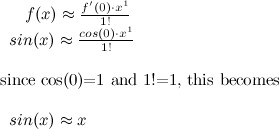
We want to approximate this function using a Taylor series polynomial. Let us do so by taking the first term of that big equation above:


So using only 1 term, our approximation is the line y=x


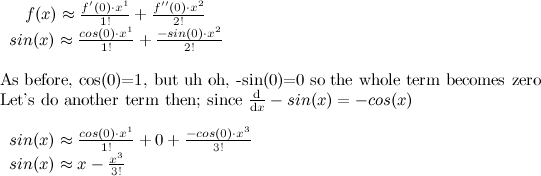
Not a very satisfying approximation, is it? What about 2 terms?


If we plot x - x3/3!, we get


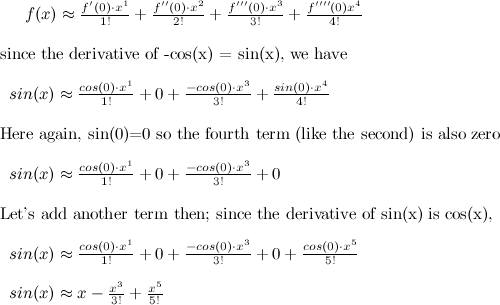
Hey wow, that's a lot better! The polynomial x - x3/3! seems to pretty exactly mimic sin(x), at least around x=0. Let's add another term.


Now our approximation is y = x - x3/3! + x5/5! which looks like this:


Even better! You can see that by adding more terms of the Taylor polynomial, we get a closer approximation of the original function. Here's a couple more terms just to illustrate:


Now the polynomial approximation is virtually indistinguishable from sin(x), at least at from x=-pi to x=pi. Here's a more "moving" display of this (credit). Notice how adding more and more terms gets us an ever-better approximation of sin(x).


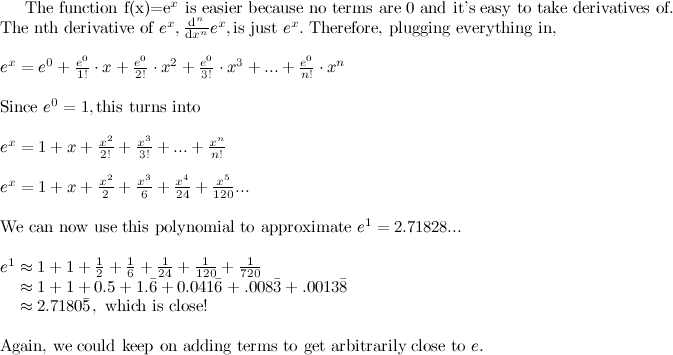
Here's an even easier example! (We are going to need this result too.)


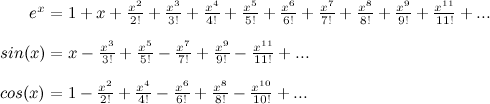
So we have Taylor series approximations for sin(x) and for ex. Now all we need is one for cos(x). It is just like sin(x) except all of the opposite terms cancel out! I'll leave this as an exercise to the reader (always wanted to say that!) and just give you the result:


Take a minute to look at these. Strange, isn't it? If it weren't for those negative signs, it looks like simply adding sin(x) and cos(x) would give us ex... Hmmm.


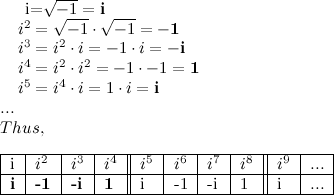
We are now in a position to make some magic happen, but one more thing remains to be done. Now's the time to recall your imaginary number i, which is equal to −1. Since i = −1, we know i2 = -1. For higher powers of i, we have the following pattern:


The pattern i, -1, -i, 1, repeats as you take ever higher powers of i. Notice that the signs are switching too! You should be excited about this. Now we're ready for the main event!


YEAH! WOOHOO! At least, that's how I felt when I first saw it.

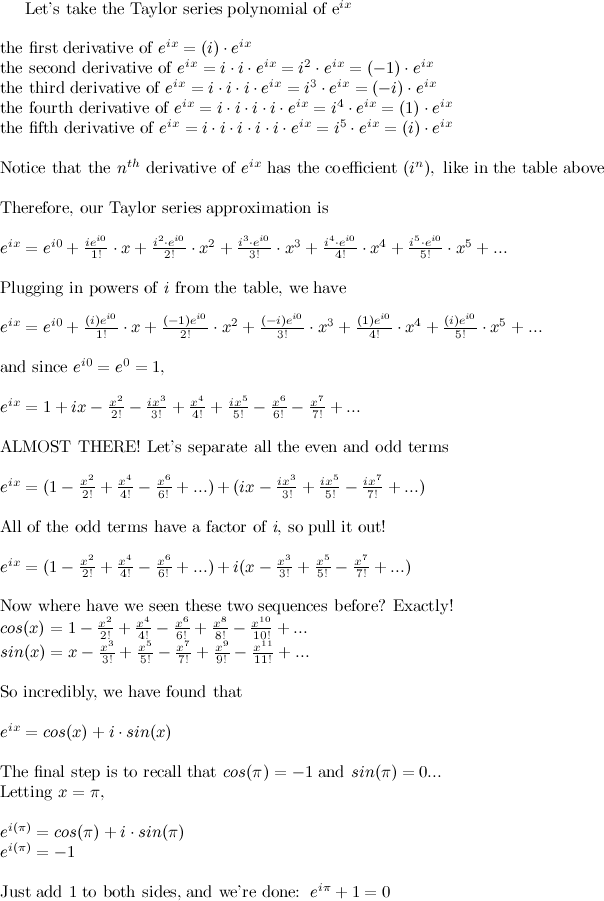
And it's not just superficially beautiful either. Before we plugged in pi, we saw that eix=cos(x) + i*sin(x). This formula has many important applications, including being crucial to Fourier analysis. For an excellent introduction, check this out.

Well, I hope that if the derivation didn't leave you reeling in perfect wonderment, you were at least given something to think about! Thanks for reading!
________________________________________________________________
*Quick derivatives refresher
It may be helpful to think of the derivative of a function f(x)---symbolized as d/dx f(x) or f'(x)---as a machine that gives of the slopes of tangent lines anywhere along the original function: if you plug x=3 into f'(x), what you get out is the slope of a line tangent to the original function f(x) at x=3. Since slope is just rise-over-run, the rate at which a function is increasing or decreasing, the derivative gives as the rate at which the original function is increasing or decreasing at a single point. If f(x) is the parabola x2, then its derivative f'(x) is 2x. At x=0, the very bottom of the parabola, we get f'(0)=2(0)=0, which tells us the line tangent to x2 at the point x=0 has zero slope (it's just a horizontal line). At x=1, the parabola has started to increase; the rate it is increasing at that point (the slope of the line tangent to that point) is f'(1)=2(1)=2; so now we have a line that goes up 2 for every 1 it goes over. At f'(2)=2(2)=4, a line that goes up 4 for every 1 it goes over. This agrees with our intuition when we look at a parabola; it is accelerating upward at an ever increasing rate.

Thursday, December 18, 2014

"Important Peculiarities" of Memory

In my high school psychology class I was told that human memory capacity was unlimited ...and it has bothered me ever since. How, I mean? Aside from the physical limitations on information storage, how could a system that remembers everything forever be evolutionarily advantageous?

This is a question I hope to explore in a deeper way sometime soon; for now, I want to talk to you about a few "peculiarities of human memory" that begin to shed some light on the situation (Bjork & Bjork, 1992). Know that I am drawing heavily from this source and their Theory of Disuse for the present discussion. This is really the coolest part, but I've left it until the end. First, let's talk about three "peculiarities"...

1. STORAGE AND RETRIEVAL ARE TWO DIFFERENT THINGS:
Analogies of human memory -- to a bucket being filled, to computer memory, to magnetic tape -- are often grossly misleading. No literal copy is recorded when you store a piece of information in memory. Learning isn't opening a drawer and putting something in; remembering isn't opening a drawer and taking something out. Indeed, your brain is not a drawer.

New things are placed into memory via their semantic connections to things already in long-term memory. The more knowledge you have of a given area, the more ways you have to store additional information about it. This is a strange biological instantiation of the Matthew effect, where "the rich get richer". To me, one of the most incredible things about being a living, thinking human is this virtually unlimited capacity for storing new information. And when I say "incredible," I mean it both in the sense of "wow, golly!" as well as in the more literal sense of "not credible."

"But wait," I hear you ask, "if my memory is so bally infinite, why can't I remember my passwords half the time? And I'm always forgetting peoples' names, and I can't remember a single word of that book I read last week, and..." As it turns out, getting information into memory is easy, but getting it out is quite another matter.

Quick, what was your childhood address? Your first cellphone number? Your seventh grade math teacher's name? Your high school ID card number? How about your old AIM password? Even the most repetitively drilled, frequently accessed pieces of information eventually become inaccessible through years of disuse. Weirdly though, this information is still stored in memory: you could probably correctly identify each of the above from a list of distracters, for example, and you probably wouldn't have any trouble remembering if you were back in the context of your home town. Perhaps if I had asked you on a different day, when you were in a different mood or frame of mind, you would've been able to retrieve the information. Often information that is effortlessly recallable on one occasion can be impossible to recall on another. Maybe you weren't able to muster the answers at first, but now after expending a bit of time and effort you have remembered. Should the old information become pertinent again, it will certainly be relearnable at an accelerated rate.

What we can and cannot retrieve from memory at any given time appears to be a function of the cues that are available to us at that time. These "cues" may be general situational factors (environmental, social, emotional, physical) as well as those having a direct relationship to the to-be-retrieved item. Cues that were originally associated in storage with the target item need to be reinstated (physically, mentally, or both) at the time of retrieval.

The main takeaway here is that our capacity for storage is far greater than our capacity for retrieval, and it appears that fundamentally different processes are responsible for each. Storage strength represents how well an item is learned, whereas retrieval strength indexes the current ease of access to the item in memory. These two strengths are independent: Items with high retrieval strength can have low storage strength (e.g., your room number during a 5-day stay at a hotel).

2. RETRIEVAL MODIFIES THE MEMORY!
The mechanical analogies have other flaws; reading from computer memory does not alter the contents, whereas the act of retrieving information in human memory modifies the system. When you remember something, that piece of information becomes easier to remember in the future (and other information becomes less retrievable). This is why taking tests is better for long-term retention than studying is. More odd is the idea that recalling Thing A can make it more difficult to recall Thing B in the future, an effect sometimes known as "retrieval competition." This topic is very, very interesting but that's all I'm going to say about it here. For more on the testing effect, check out this paper.


3. LONG-HELD MEMORIES ARE HARD TO REPLACE
Through disuse, then, things become hard to retrieve. But oddly, the earlier the memory was constructed (i.e., the older it is), the more easy it is to access relative to related memories constructed later. Say you decide to change your email password; after doing so, the new password will be the most readily accessible of the two. If you use it to log in tomorrow, you will have little trouble recalling it. However, if you do not have occasion to use either password for a while (new or old), the old password becomes far easier to remember relative to the new password.

Consider athletes: a long layoff often leads to the recovery of old habits. This can help an athlete recover from a recent funk, or it can be a major setback for a rookie who has been rapidly improving. In occupational settings too, and even the armed services, people can appear to be well-trained but then turn around and take inappropriate actions at a later time (i.e., fall back on old habits), particularly in stressful situations. It may even result in the unreasonable surprise we often feel when we see that a child has grown, or a friend has aged, or a town has changed; perhaps we are overestimating these changes because our memory of the child, friend, or town is biased toward a past version of them stored more securely in memory.

This stuff has firm support from laboratory studies too, but I don't want to bore with great detail. Suffice it to say that, if experimental subjects are given a long list of items to memorize and then afterwards asked to recall all of the times that they can remember, there will be a strong recency effect: the items later in the list will be more easily recalled. If, later on (say a day or a week later), subjects are asked to recall all of the items they can remember, there will be a strong primacy effect: the items appearing first will be better recalled than the items appearing later. That this, with the passage of time there is a change from recency to primacy. This finding holds across different delays, tasks, materials, and even species (Wright 1989)!


The Theory of Disuse:
In brief, Bjork and Bjork's (1992) theory states that items of information, no matter how retrievable or well-stored they are in memory, will eventually become nonrecallable if they are not used enough. This is not to say that the memory has decayed or been deleted... it is just inaccessible. Storage and retrieval are two very different things; storage strength reflects the how well-learned the item is, while retrieval strength represents how easy it is to access the item. Unlike storage capacity, retrieval capacity is limited; that is, there are only so many items that are retrievable at any given time in response to a cue or set of cues. As new items are learned, or as the retrieval strength of certain items in memory are increased, other items become less recallable. These competitive effects are generally determined by category relationships defined semantically or episodically; that is, a given retrieval cue (or cues) will define a set of associated items in memory, and the dynamics of competition for retrieval capacity take place across the set.

The theory makes many predictions that account for those peculiarities stated above. Retrieval capacity is limited, not storage capacity, and the loss of retrieval access is not a consequence of the passage of time per se, but of the learning and practice of other items. Retrieving an item from memory makes it easier to retrieve that item in the future but makes it more difficult to retrieve other associated items. The theory also explains why overlearning (additional learning practice after perfect performance is achieved) slows the rate of subsequent forgetting: perfect performance is a function of retrieval strength (which cannot go beyond 100%), whereas additional learning practice continues to increase storage strength. Finally, the spacing effect--the fact that spreading out your study sessions is far more effective for long-term retention than is cramming--can be accounted for by the theory as well. Spacing out repetitions increases storage strength to a greater extent than does cramming, which in turn slows the rate of loss of retrieval strength, thereby enhancing long-term performance. Importantly, cramming can still produce a higher level of initial recall than that produced by spacing, but like the switch from recency to primacy, the switch happens rather quickly.

Again, to spin an evolutionary just-so story, all of this seems pretty adaptive. It is sensible that the items in memory we have been using lately are the ones that are most readily accessible; the items that have been retrieved in the recent past are those most relevant to our current situation, interests, problems, goals... and in general, those items will be relevant to the near future as well. To keep the system current, it makes good sense that we lose access to information that we have quit using: for example, when telling someone our address, it would not be useful to recall every home address we have had in the past.

I look at all of this and I see a selection process at work. The set of items in memory is like so many species in an ecosystem; introduce a new species, and it will die unless it finds a niche (new information must be learned well enough to make it into long-term memory in the first place). Some species don't have much to do with one another, whereas others are mutually dependent and others in direct competition (increasing the retrieval strength of one item reduces the retrieval strength of other, related items). Species with low fitness diminish relative to those with high fitness because they cannot stay  competitive (the items that are used the most proliferate at the expense of items that don't, the item's fitness being determined by the history and recency of its use). Longer, more established species are better adapted to their environment and thus tend to outcompete newcomers (older, more well-connected items memory are easier to recall than newly learned items lacking a deep connection to other items in memory). Species die out, but rarely go completely extinct; instead, they can emigrate elsewhere. They are still extant, but no longer part of the active ecosystem. When conditions improve and it becomes adaptive to return to the ecosystem again, the species is easily reinstated. My metaphor falls apart in places, but I find the selection scheme a good jumping of point for most discussions of this nature.